Autonomous AI Trading System
Six phases, fully autonomous — Claude Sonnet generates signals, an execution engine validates and places real paper trades on Alpaca, and a circuit breaker plus backtester make sure nothing goes sideways.
Signal to trade. Zero clicks.
- Claude Sonnet analyzes market data for each ticker and produces a structured Buy, Hold, or Underweight signal with a confidence score and written rationale — no hardcoded rules
- The execution engine validates every signal through five risk gates before placing a single Alpaca market-buy order: market hours, available funds, position cap, and correlation limits
- A 6-hour cron monitors every open position and places a market-sell automatically when the +10% profit target or −5% stop-loss threshold is crossed
- A circuit breaker reads portfolio equity at day-open and halts all new buys the moment it drops more than 10% — protecting against runaway drawdowns
- Every weekday evening, a digest fires via Resend email and Telegram with signal count, current P&L, and realized gains from the day
Six phases, one system.
-
Phase 1 — Signal Generation
TradingAgents runs Claude Sonnet in parallel across multiple tickers. Each agent receives recent price data and produces a structured signal: Buy, Hold, or Underweight — with a 0–100 confidence score and a written rationale stored to Supabase.
-
Phase 2 — Execution Engine
Buy signals pass through five sequential risk gates: market hours check, available funds check, per-ticker position cap, portfolio correlation threshold, and circuit breaker status. Any failed gate rejects the trade with a logged reason. Approved signals become real Alpaca paper market-buy orders.
-
Phase 3 — Exit Monitoring
A 6-hour cron polls every open position. If current price is ≥ +10% above entry (profit target) or ≤ −5% below entry (stop-loss), the engine places a market-sell on Alpaca and writes the exit price, time, status, and realized P&L back to Supabase.
-
Phase 4 — Daily Digest
A weekday cron fires at 9PM UTC. It reads the day's signals, current positions, and any realized P&L from Supabase, then sends a structured summary via Resend email and a Telegram bot message. One concise alert per day — no noise.
-
Phase 5 — Circuit Breaker
At the start of each UTC day, the system reads portfolio equity and stores it as the day-open baseline in Supabase. Every time the execution engine is invoked, it checks whether current equity has fallen more than 10% below that baseline. If so, all new buys are blocked for the rest of the day — the circuit breaker fails open, so the system keeps running but stops spending.
-
Phase 6 — Execution-Logic Backtester
An on-demand
POST /backtestendpoint runs the real position-sizing and exit functions against 2 years of OHLCV data using deterministic SMA-crossover signals as a test harness. Reports return, Sharpe ratio, max drawdown, and win rate vs. buy-and-hold — validating execution logic without burning AI credits.
See the full system live.
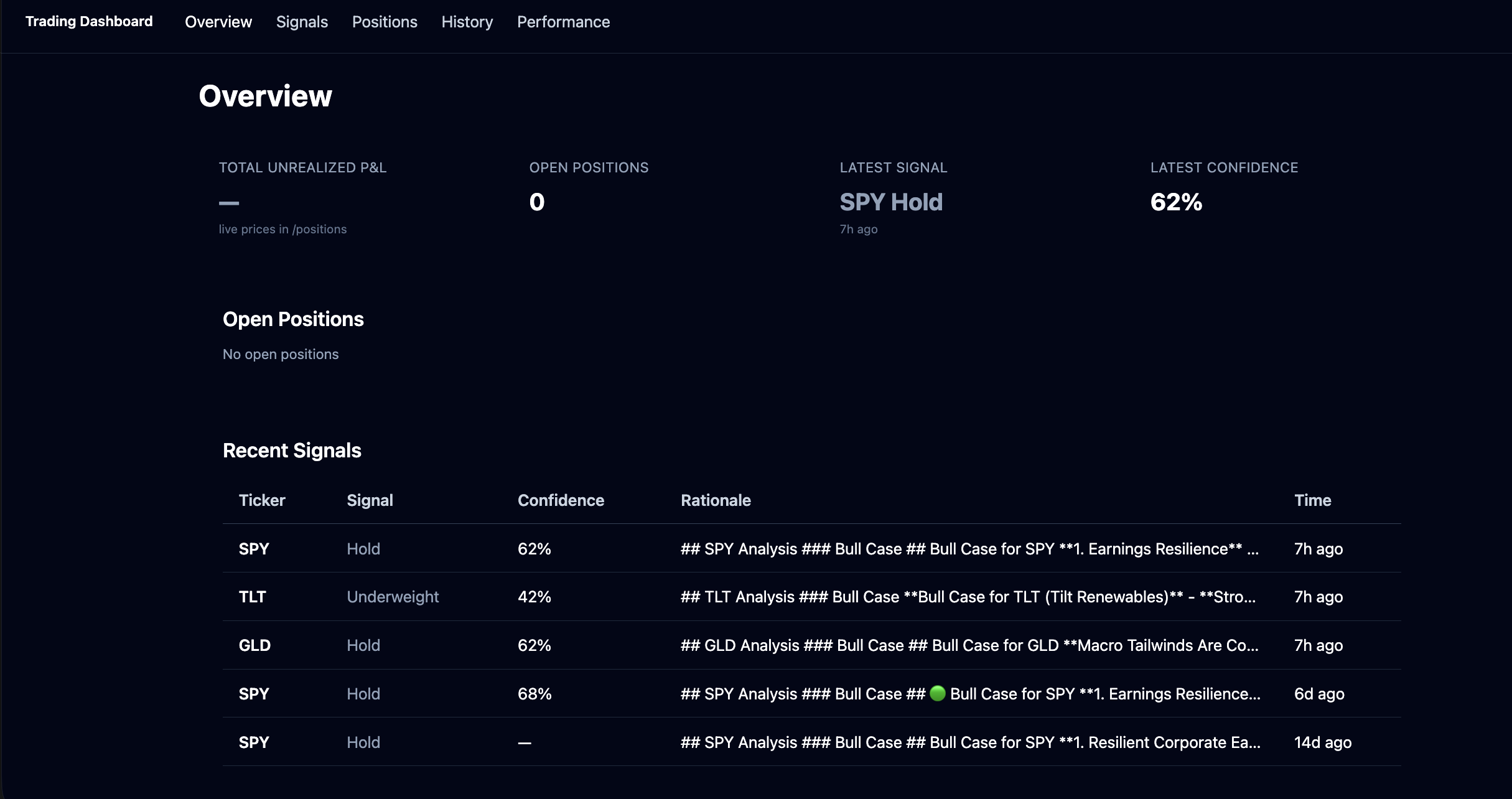
Full walkthrough — signal generation, trade execution, exit logic, circuit breaker, backtester, and the live dashboard. All six phases running for real.
Everything is deployed.
-
7 API endpoints on Render
/run·/poll-orders·/daily-digest·/breaker-status·/accuracy-report·/backtest·/health. Python 3.11.9, pinned. -
3 scheduled cron jobs
Weekly signal run (Monday 9AM UTC) · 6-hourly exit polling · weekday daily digest (9PM UTC). All managed on Render's native cron scheduler.
-
5-page Next.js dashboard on Vercel
Overview · Signals · Positions (live Alpaca prices) · History · Performance (Chart.js P&L chart). Password-gated, reads Supabase server-side. RLS enabled — anon role denied.
-
101 passing tests
TDD'd across all six phases — signal generation, execution, exit logic, circuit breaker, accuracy reporting, and backtester. Run under Python 3.11 in CI.